Sewer blockages
Silt, grease and debris build up quietly until flow stops. By the time it is reported, the blockage has usually been forming for months.
Robotic pipeline inspection · Surat, Gujarat
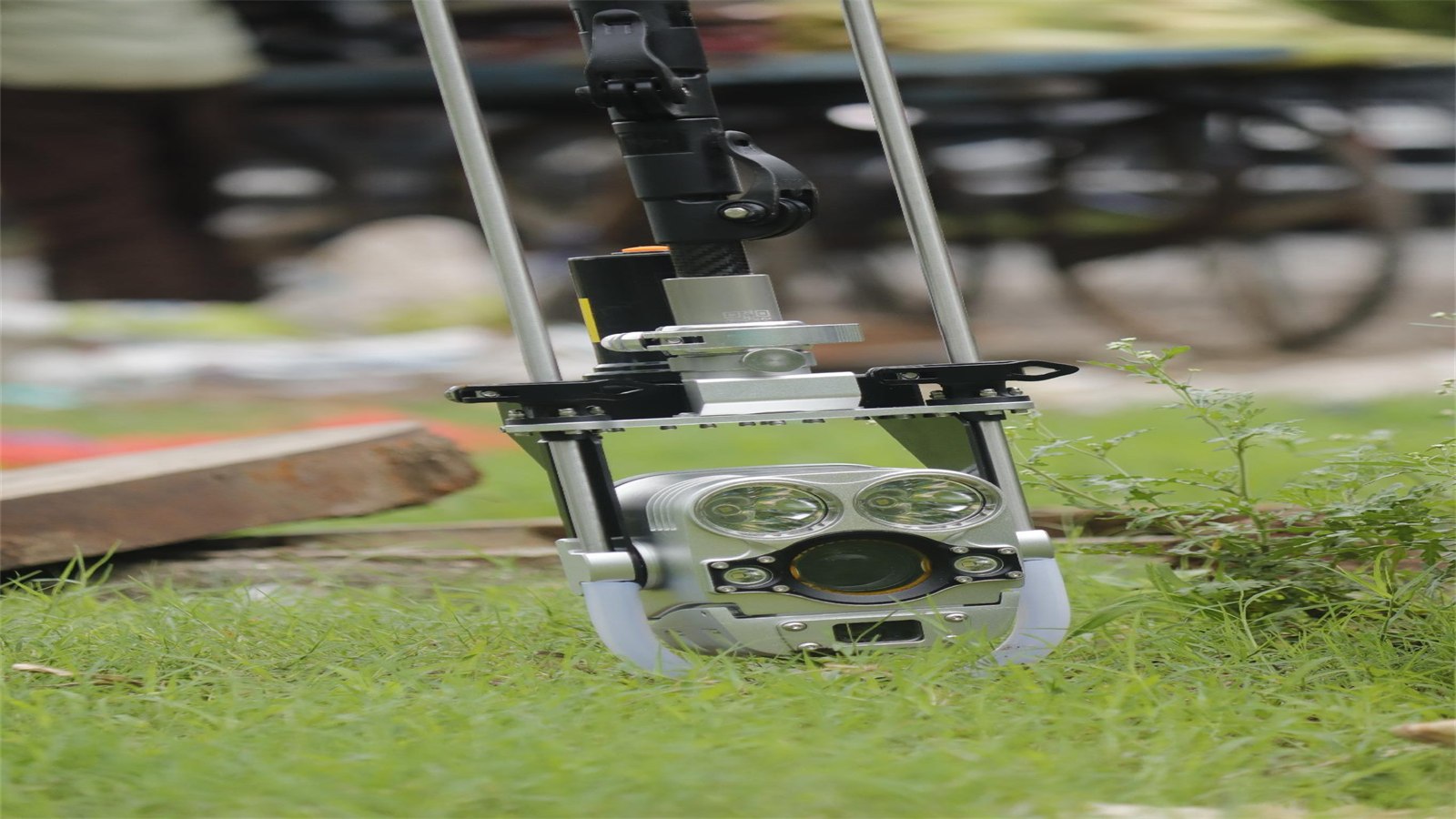
We send robotic crawlers and HD periscopes into sewer, stormwater and utility pipelines from 150 mm to 3,000 mm, then hand you the video, the defect coding and the coordinates your engineers can actually act on.

The problem
An ageing network only tells you it is failing when the road collapses or the sewage backs up. Six problems show up again and again in municipal drainage — and all six start with the same gap: nobody can see the pipe.
Silt, grease and debris build up quietly until flow stops. By the time it is reported, the blockage has usually been forming for months.
Untreated overflows create public-health risk, environmental damage and a paper trail that lands on the corporation's desk.
Excavating on suspicion means traffic jams, damaged utilities and civil repair bills that dwarf the cost of looking first.
Missing geospatial data turns every trench into a gamble — and accidental strikes on water, gas or power lines into incidents.
Paper maps and outdated drawings prevent planned maintenance. Nobody can prioritise a network that has never been surveyed.
Reactive emergency repairs cost three to five times more than targeted maintenance planned from real condition data.
Choose the method that matches the pipe, the flow and the question you need answered. Most programmes use all three.
Four stages, one chain of evidence. Nothing in the report is an opinion — every line traces back to a video timestamp and a metre mark.
Remote-controlled crawler or periscope enters the pipeline. Continuous HD recording, no confined-space entry.
Cracks, joint displacement, root intrusion, debris and deformation are identified and located on the pipe run.
Defects are graded to a standard library, illustrated with stills and compiled into an engineering report.
Results are tied to manhole coordinates and loaded into QGIS or your GIS platform as a living asset record.
Our coding follows the structural and service defect classes used in the New Zealand Gravity Pipe Inspection Manual (NZPIM) and EN 13508 practice — the same framework our team applied on New Zealand drainage contracts.
How we grade defectsBoth inspection systems are ours. That means we can mobilise on your schedule, not when a hire company has a unit free.
Our operating procedure runs from desktop study to signed report in five phases. Safety and data quality are built into the sequence, not bolted on.
Historical logs, drawings and pipe schedules reviewed; route, access and traffic zones mapped in GIS.
Work perimeter, cones and signage set; PPE on; control unit, reel and lighting calibrated.
Manhole opened with mechanical lifters, ventilated, depth and invert level measured, chamber filmed in 360°.
Crawler deployed on the invert, driven at controlled speed with chainage logged for every defect.
Media archived, defects coded, report compiled and handed over with a clear recommendation.
Not every inspection ends in a clean video. These are real Surat Municipal Corporation assessments — including the ones where the right answer was to stop, clean, control the flow and come back.
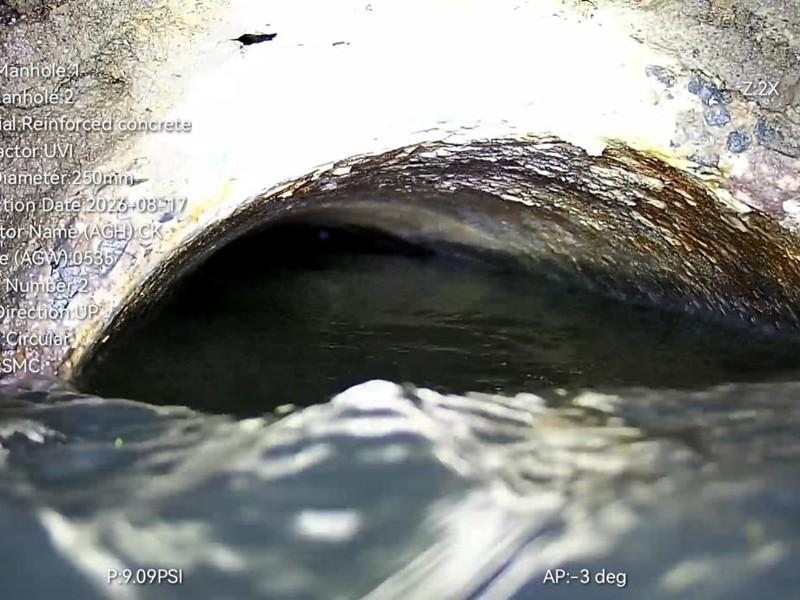
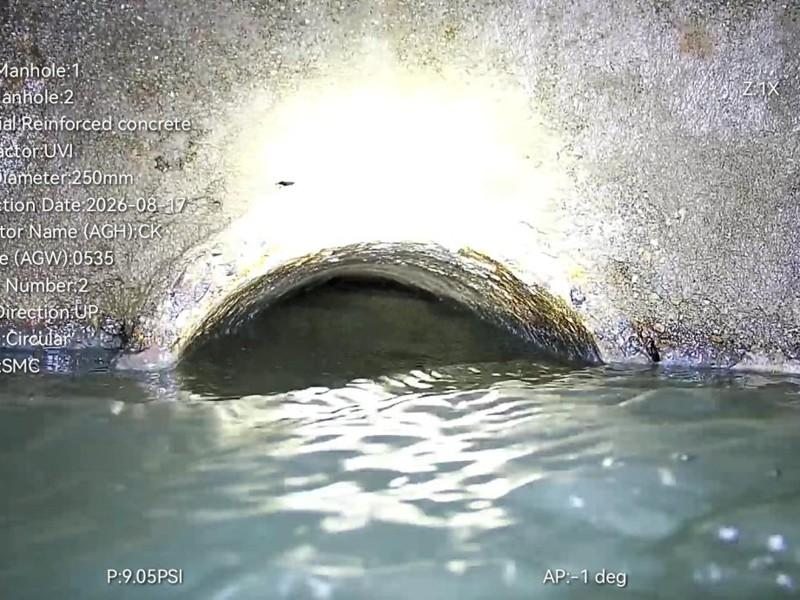
Water sat at 80–100% of pipe height and vertical pipe displacement was visible in the main run. An E25 periscope diagnostic was completed; the crawler survey was scheduled for a controlled low-flow window.
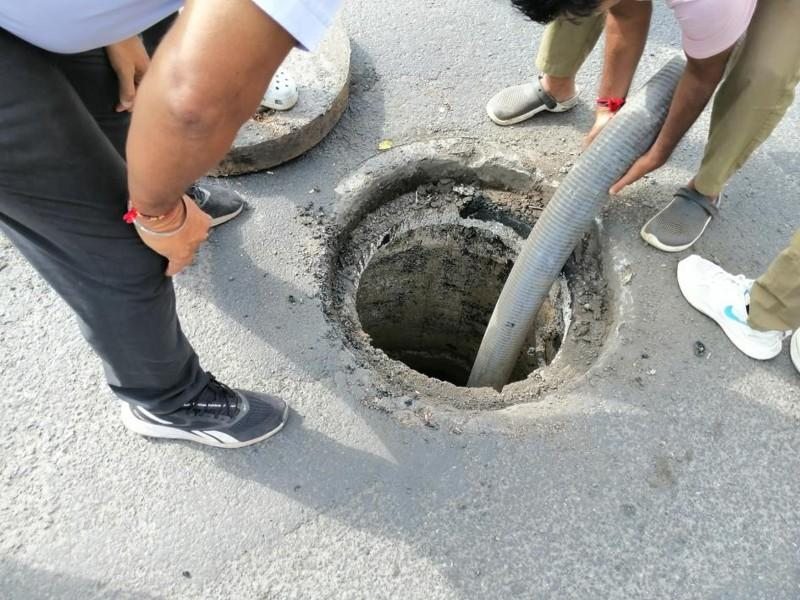
Jetting and suction cleared roughly 0.7 m of heavy silt around MH-2, restoring flow. The final run then revealed a broken, collapsed section that needs structural repair before inspection can continue.
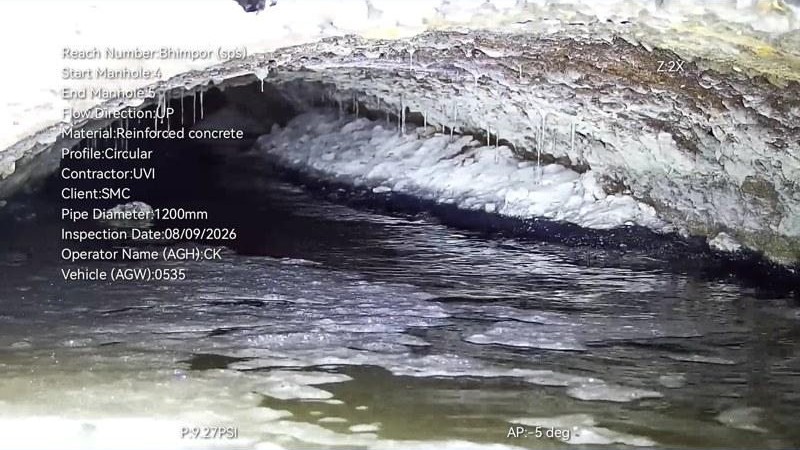
The 1200 mm line was packed with debris and turbid water. Only 0.90 m could be inspected from the SPS manhole. We reported the limit honestly and specified cleaning, bypass pumping and an upstream re-survey.
CCTV inspection is standard practice in Auckland — written into council infrastructure requirements and used by major contractors to plan maintenance instead of reacting to failures. Our team learned the workflow there and brought it home.
You cannot effectively manage what you cannot see.
Straight answers
A survey is only useful if you know its limits. These are the field constraints we plan around on every job — and tell you about before we mobilise.
A submerged pipe crown hides everything above the waterline. In live sewers we schedule inspection into low-flow windows, use flow control or temporary bypass, and — where flow cannot be reduced — record what is genuinely visible rather than inferring the rest.
Dense mud, gravel or compacted debris can bury the invert and stop a crawler outright. Pre-cleaning by high-pressure jetting or suction is usually required, and it is scoped separately so you are not paying for cleaning you did not ask for.
Fast, churning flow vibrates the camera and distorts the image. We stabilise with skids and flow-timed scheduling, but a turbulent line will always produce weaker evidence than a calm one.
CCTV sees the inside wall only. Soil support, bedding, voids behind the pipe and external corrosion cannot be assessed from a crawler. Where those matter, we say so and recommend complementary investigation.
Manholes paved over by road works or metro construction may need excavation before any equipment can enter. Traffic-controlled access may also need police permission and a planned window.
A collapsed pipe halts crawler advancement. We record the obstruction position and extent, then recommend repair before re-inspection — continuing past a collapse would produce footage that misrepresents the asset.
Tell us the pipe diameter, the length and the access constraints. We will tell you what is feasible, what it costs and what the report will contain.